Why it’s more widespread than most people realize — and what to do about it
There’s a good chance you or someone close to you is walking around with a Vitamin B12 deficiency right now — and has no idea. That’s not an exaggeration. A national-level nutrition survey found that over 52% of women of reproductive age in Pakistan were B12-deficient. In diabetic patients on long-term metformin therapy — one of the most commonly prescribed medications in the country — studies conducted at Pakistani hospitals found deficiency rates between 31% and 44%. And those are only the cases being measured in clinical settings.
The broader picture is likely worse, because B12 deficiency is famously slow and quiet. Symptoms build up over months or years, often getting dismissed as tiredness, stress, or simply getting older. By the time someone connects the dots, the deficiency has usually been sitting there for a long time.
This guide covers what B12 actually does, why deficiency is so common in Pakistan specifically, how to recognize the symptoms, and how to address it — including what to look for in a B12 supplement so you’re actually solving the problem.
What Vitamin B12 Actually Does in the Body
B12 — also called cobalamin — is one of those vitamins that’s involved in so many body systems that its deficiency shows up in unexpected places. The major ones:
- Red blood cell production: B12 is essential for making healthy red blood cells. Without enough of it, the body produces abnormally large red blood cells that can’t carry oxygen efficiently. This is called megaloblastic anemia, and it’s one of the most common consequences of long-term B12 deficiency.
- Nervous system health: B12 maintains the myelin sheath — the protective coating around nerve fibers. When B12 is chronically low, this coating degrades. The result is nerve damage that can show up as tingling in the hands and feet, difficulty walking, memory problems, and in severe cases, permanent neurological damage.
- Brain function and mood: B12 is involved in the synthesis of serotonin and dopamine. Low B12 has been consistently linked to depression, anxiety, brain fog, and cognitive decline — particularly in older adults.
- DNA synthesis and cell repair: Every cell in your body depends on B12 for healthy DNA replication. This is particularly important during pregnancy, where deficiency is linked to neural tube defects in the developing baby.
- Energy metabolism: B12 helps convert food into usable energy. Persistent fatigue and weakness — even after a full night’s sleep — is one of the earliest and most common signs of deficiency.
Why B12 Deficiency Is So Common in Pakistan
Several factors specific to Pakistan make this deficiency far more prevalent here than in many Western countries:
Diet
B12 is found almost exclusively in animal products — meat, poultry, fish, eggs, and dairy. While Pakistan is not a vegetarian country, actual consumption of high-B12 foods like red meat, liver, and fish is often lower than it appears. Budget constraints, cooking habits, and the dominance of wheat and rice-based meals mean that many people are consuming far less B12 than the daily recommended 2.4 micrograms, without realizing it.
Metformin Use in Diabetic Patients
Pakistan has one of the highest rates of Type 2 diabetes in the world, and metformin is the first-line treatment for the vast majority of patients. The problem is that long-term metformin use is strongly associated with reduced B12 absorption in the gut. A cross-sectional study at Sheikh Zayed Hospital in Rahim Yar Khan found that 36.54% of T2DM patients on long-term metformin therapy were B12-deficient. Another study from Peshawar reported similar numbers. Yet routine B12 screening for diabetic patients on metformin is not standard practice across most Pakistani hospitals.
Gut Health Issues
B12 requires a protein called intrinsic factor — produced in the stomach — to be absorbed properly. Conditions like gastritis, H. pylori infection (extremely common in Pakistan), frequent use of antacids and PPIs (proton pump inhibitors), and general gut inflammation all significantly reduce B12 absorption, regardless of how much B12 is consumed through food.
Thyroid Disease
Hypothyroidism is widespread in Pakistan, particularly among women. A study from Karachi found that approximately 40% of hypothyroid patients had B12 deficiency. The two conditions interact in ways that make each other worse — and since thyroid disease is already frequently underdiagnosed in Pakistan, the B12 piece often gets missed entirely.
Pregnancy and Breastfeeding
Pregnant and breastfeeding women have increased B12 requirements (2.6–2.8 mcg daily) and are more vulnerable to depletion. A baby born to a B12-deficient mother and then exclusively breastfed will develop B12 deficiency of their own — with serious consequences for neurological development.
Symptoms You Might Be Ignoring
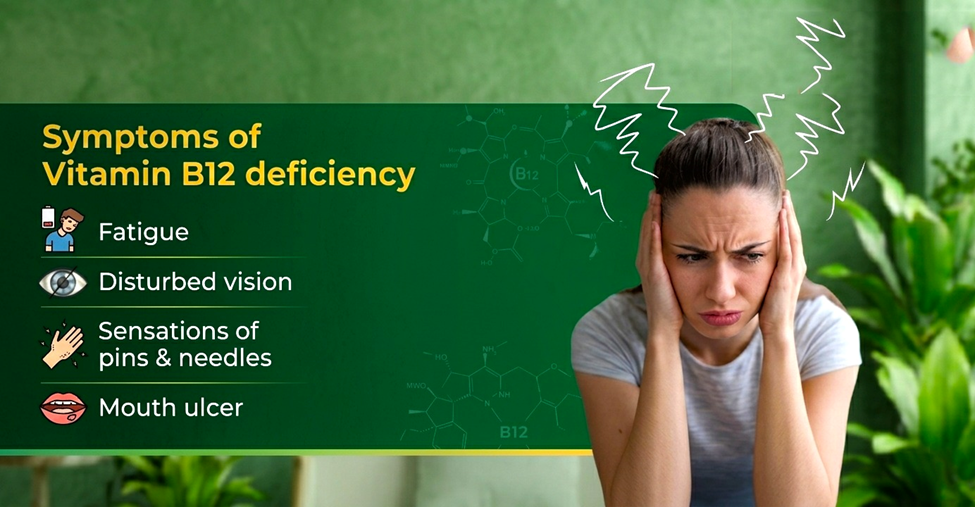
The difficulty with B12 deficiency is that its symptoms are easy to attribute to other things:
| Symptom | Why It Happens | Often Mistaken For |
| Persistent fatigue | Poor oxygen delivery from abnormal red blood cells | Overwork, poor sleep, stress |
| Tingling/numbness in hands & feet | Nerve myelin breakdown | Poor circulation, sitting too long |
| Forgetfulness/brain fog | Reduced neurotransmitter production | Aging, overthinking, anxiety |
| Depression or low mood | B12 is needed for serotonin synthesis | Life stress, situational sadness |
| Pale or yellowish skin | Anemia reduces red blood cell count | Skin tone, sun exposure |
| Sore or an inflamed tongue | Rapid cell turnover is affected in the mouth | Infections, vitamin C deficiency |
| Breathlessness on mild exertion | Anemia reduces oxygen capacity | Fitness levels, heat |
| Dizziness or balance issues | Nerve damage affecting coordination | Low blood pressure, inner ear |
What makes this particularly tricky is that B12 deficiency can be present for years before symptoms become obvious. The body stores B12 in the liver, and it takes time for those stores to deplete. By the time symptoms are noticeable, the deficiency is usually well-established.
Diagnosing B12 Deficiency in Pakistan
The straightforward way to confirm B12 deficiency is a serum B12 blood test. Normal levels are generally considered to be above 300 pg/mL, with levels below 200 pg/mL indicating deficiency. The 200–300 range is considered borderline and worth monitoring.
If you fall into any high-risk category — you’re on long-term metformin, you have thyroid disease, you’ve been on antacids or PPIs for extended periods, you’re pregnant or planning to be, or you eat very little meat or dairy — getting your B12 checked is worth doing proactively rather than waiting for symptoms.
One important caveat: if you’re taking a high-dose Biotin supplement (5000mcg or above), stop it for a few days before the test. High Biotin can interfere with certain blood assays and produce falsely normal or abnormal B12 readings.
Choosing the Right B12 Supplement — What to Look For
Not all B12 supplements are the same. Two things matter most: the form of B12 and the dose.
The Form: Methyl-cobalamin vs Cyanocobalamin
Most inexpensive B12 supplements use cyanocobalamin, a synthetic form that the body has to convert into a usable form before it can work. It’s stable and affordable, but it requires additional metabolic steps and is used less efficiently by some people, particularly those with certain genetic variants.
Methyl-cobalamin is the active, bioavailable form of B12 — the form your body can use directly without conversion. It also tends to stay in the body for longer. For people who want to address a deficiency efficiently, methyl-cobalamin is the better choice. Nature’s Bounty B12 1000mcg Methylcobalamin is specifically formulated in this preferred form – not a cheaper alternative.
The Dose: How Much Is Enough?
The recommended daily intake of B12 is 2.4 mcg, but supplement doses are typically much higher – and for good reason. B12 absorption through the gut is not 100% efficient, especially if gut health is compromised. Higher doses compensate for limited absorption. Here’s how the Nature’s Bounty B12 range breaks down:
| Product | Dose | Form | Pack Size | Best For | Price (Rs.) |
| NATURE’S BOUNTY B12 | 500mcg | Cobalamin | 100 Q-D tablets | Daily maintenance, mild deficiency | 3,596 |
| NATURE’S BOUNTY B12 | 1000mcg | Cobalamin | 100 tablets | Standard deficiency correction | 4,226 |
| NATURE’S BOUNTY B12 Methylcobalamin | 1000mcg | Methylcobalamin | 60 tablets | Best absorption, active form | 3,795 |
| NATURE’S BOUNTY B12 | 2500mcg | Cobalamin | 75 Q-D tablets | Moderate-severe deficiency | 4,496 |
| NATURE’S BOUNTY B12 | 5000mcg | Cobalamin | 40 Q-D tablets | Severe deficiency, metformin users | 4,496 |
Quick Dissolve (Q-D) tablets dissolve under the tongue, bypassing the gut entirely — which is particularly useful for people whose gut absorption is compromised (metformin users, those with gastritis or H. pylori, or anyone on long-term antacids).
Imported vs Local Brand B12 — What’s the Difference
Local brands offer accessible B12 options at lower upfront costs and are available in pharmacies across Pakistan. That’s a real convenience for many people.
Where Nature’s Bounty differentiates is in manufacturing consistency and ingredient form. Produced in FDA-regulated facilities in the United States since 1971, each batch is laboratory tested for purity and potency. The methyl-cobalamin formulation in particular uses the active form of B12 that many local brands don’t offer. And with pack sizes from 40 to 100 tablets, the per-tablet cost is competitive when calculated across the full supply period.
Frequently Asked Questions
Can B12 deficiency cause permanent damage?
Yes — if left untreated for a long time, nerve damage from B12 deficiency can become irreversible. This is why early detection and correction matters. Fatigue and mood issues typically resolve with supplementation, but long-standing neurological symptoms may only partially improve.
How long does it take for B12 supplements to work?
Energy levels and mood often improve within 4 to 6 weeks of consistent supplementation. Neurological symptoms take longer — typically 3 to 6 months — and may not fully resolve if damage is advanced. Blood levels usually normalize within 1 to 2 months.
Can you get too much B12?
B12 is water-soluble, meaning excess is excreted by the kidneys rather than stored in harmful amounts. There is no established upper tolerable intake level for B12 — it has not been shown to cause toxicity even at very high doses. That said, stick to recommended supplement doses unless advised otherwise by a doctor.
Should I take B12 with food?
For standard tablets, taking them with food can help with absorption and reduce any mild stomach discomfort. Quick Dissolve tablets are taken under the tongue and are designed to bypass the digestive process, so food timing matters less for those.
The Bottom Line
Vitamin B12 deficiency is not a niche problem in Pakistan. With over half of women of reproductive age showing deficiency in national surveys, with hundreds of thousands of diabetic patients on metformin whose B12 is being quietly depleted, and with a diet that doesn’t reliably provide enough B12 for a significant portion of the population, this is a widespread public health issue that most people haven’t connected to their own day-to-day symptoms.
If you’re constantly fatigued, struggling with focus, experiencing tingling in your extremities, or dealing with persistent low mood — and none of the usual explanations quite fit — getting your B12 checked is one of the simplest and most useful things you can do.
Nature’s Bounty B12 supplements — including the active methyl-cobalamin form — are available at https://importedvitamins.com/ with Cash on Delivery across Pakistan and free shipping. Every product is manufactured in FDA-regulated facilities and laboratory tested for purity and full potency.